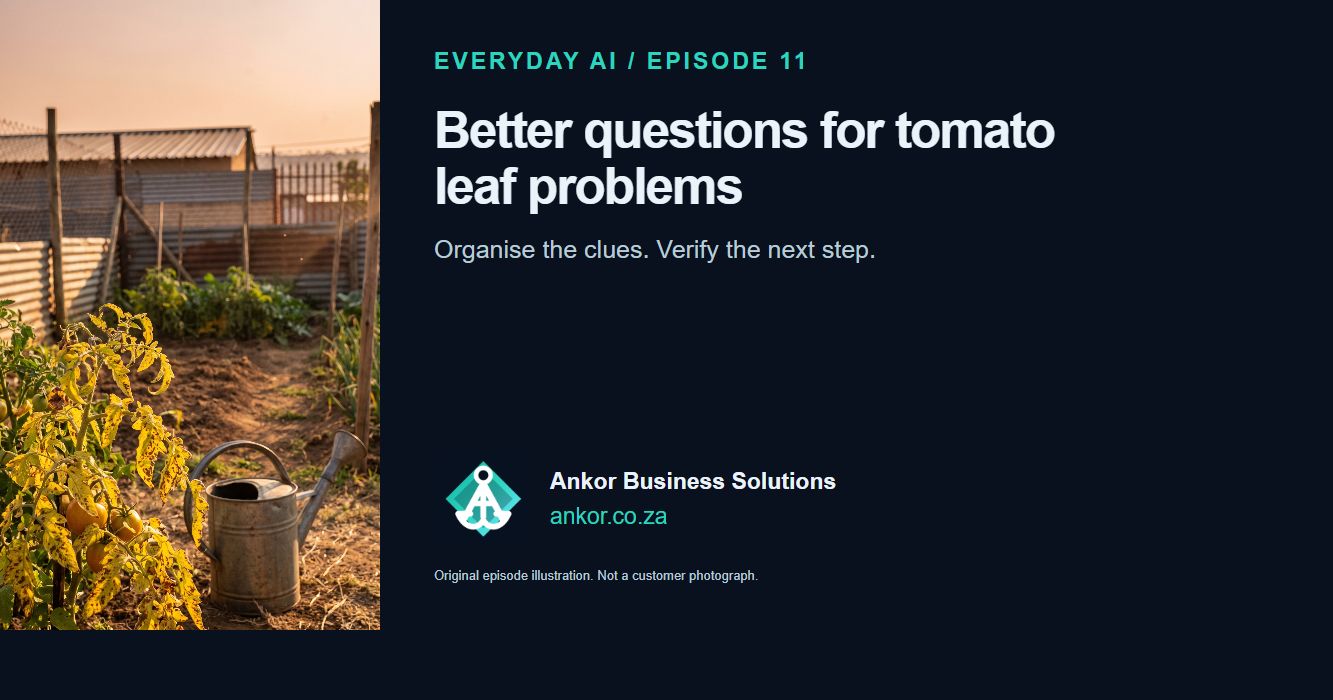
Tomato leaf problems: start with a useful record
Take clear photographs in daylight: one of the whole plant, one of an affected leaf and one showing the growing container or bed. If possible, include the underside of the leaf. A photograph with several plants mixed together makes it harder to explain which one you mean. Write down when you first noticed the change. Say whether it is affecting older or newer leaves and whether other plants nearby look similar. Describe what you see rather than giving it a disease name: yellow areas, brown spots, curling edges or patches of damage. Add information the picture cannot show: the kind of plant, whether it is in a pot or the ground, recent weather, watering routine, any feed or garden product used and a broad location. Your town or climate region is enough. There is no need to upload your home address or a photograph containing people or private documents.Ask for possibilities and ways to check
The Royal Horticultural Society’s tomato leaf guide explains that growing conditions, including water, light, temperature and nutrients, can affect leaves. Pests and diseases can also be involved. Similar-looking symptoms therefore need context. Instead of asking an AI assistant for a certain diagnosis of your tomato leaf problems, ask it to separate what is visible from what is unknown. Request a few possibilities, the evidence supporting each and the observations that would help distinguish them. If it supplies a confident answer without acknowledging uncertainty, ask it to reconsider. This is a useful structure for the reply:- What can you actually see in the photograph?
- Which details are missing?
- What are several possible explanations?
- Which observations can I make without treating the plant?
- What should I ask a local nursery to check?
The prompt in the video
The on-screen prompt is:Why are my tomato leaves turning yellow with brown spots? How do I fix it cheaply?The spoken version asks why the leaves are turning yellow and how to fix it. For a more cautious follow-up, add this instruction:
Use these photos and my garden notes to suggest possible explanations, not a diagnosis. Separate visible observations from guesses. Tell me what else to check and what to ask a local nursery before changing care or using a product.You can add your actual observations in normal sentences. Do not fill missing details with guesses just to make the prompt sound complete. If you do not know when the plant was last fed, say that.
Read the answer before changing anything
AI may suggest watering changes, feeding, removing leaves or applying a product. Each suggestion needs to fit the actual problem. More water is not automatically better; a product sold for one issue may be irrelevant to another. Keep the original care notes beside the answer. Mark any statement that assumes a fact you did not supply. If the assistant claims that a fungus is present, ask which visible evidence supports that possibility and what would be needed to confirm it. Take that question to the nursery. Avoid making several changes at once based only on the chat. Doing so can make it harder to understand what happened next. Ask the adviser which observation or action should come first and when to check again. Record the advice and the date.Make the nursery visit specific
Show the photographs and explain the growing conditions. You might ask, “Does this look like a care problem, a pest or something that needs closer examination?” Then ask what additional information would help. The aim is not to get the nursery to endorse an AI answer. It is to give them a clear record so they can assess the plant independently. Mention any previous product use and bring the product information if it could be relevant. If a garden product is recommended, check that it is appropriate for the plant and intended use. Read the actual label and follow it. AI should not invent a dilution, mixture or harvest interval. For food plants, ask specifically about the label’s food-crop instructions before using anything.Follow up with observations
After following verified advice, take another photograph from a similar angle and note what changed. Include both improvements and new problems. A record is more useful than “it looks worse”, because you can compare the affected leaves, new growth and the overall plant. You can ask AI to format the notes into a simple timeline for a follow-up conversation. Keep the observations in your own words and correct any summary that adds a result you did not see. This is also a way to learn your own garden’s patterns. You may notice that several plants changed after the same weather event or that only one container is affected. Those observations are yours; the assistant’s job is to organise them.Adapt the example wherever you garden
The series was made in South Africa, but this way of questioning tomato leaf problems works for gardeners elsewhere too. Tell the assistant the actual month, climate and growing conditions. Advice written for a different season or location may not fit. A small balcony pot, a greenhouse and an outdoor vegetable bed are different settings. Include that difference rather than assuming the assistant knows it. Do not treat a suggested “cheap fix” as a verified local price or a guaranteed recovery.Frequently asked questions about tomato leaf problems
Can AI diagnose tomato leaf problems from a photo?
No. It can suggest possibilities and questions, but a photograph alone does not establish the cause. Verify treatment decisions with a knowledgeable local adviser.Should I spray the plant if the AI suggests it?
Do not choose a spray solely from an AI reply. Ask a local nursery or horticultural adviser and follow the relevant product label.What information should I include?
Include clear photos, the plant type, growing setting, recent care, weather and when the change started. Avoid sharing your home address or unrelated private information.Why are my tomato leaves turning yellow with brown spots?
There are several possible reasons. The Royal Horticultural Society notes that water, light, temperature and nutrients can all affect tomato leaves, and pests and diseases can too. Similar-looking symptoms need context, so record what you see and ask a local nursery to check.Is the cheap fix an AI suggests safe to use?
Not automatically. Treat any suggested fix as a question for your nursery, not an instruction. If a product is recommended, read the actual label and follow its instructions for food crops.Build confidence with everyday AI
If you are new to prompting, start with Ankor’s ChatGPT for Beginners course. The same habit of checking a summary against its source applies when you explain an official letter with AI. Growing something bigger than tomatoes? The Essential Business Package gives a one-person business a guided weekly rhythm. Garden advice in this article is general education, not a capability claim for that product. Next time you spot tomato leaf problems, take the three photos first and write two lines of notes. That record is worth more than any confident answer, from a search engine or an AI. Follow Everyday AI from Ankor for practical ways to use AI while keeping your own judgement involved.Watch Everyday AI Episode 11
Ankor tips
Stay in the loop
Practical AI tips for small businesses and the odd product update. No spam, unsubscribe any time.

