Short answer: AI consulting for small business usually costs roughly $80 to $600 an hour for advice, $2,000 to $10,000 for a fixed project, or $1,500 to $15,000 a month for a retainer or embedded advisor, depending on who you ask. A consultant finds the jobs AI can take off your plate, then helps you set one or two up. Prices below were read on 24 October 2026 and can change.
That range is wide because nobody sells the same thing. Some consultants write a report. Some build the thing. Some sit next to you while you build it. This guide explains what an AI consultant does, how they charge, what the published prices say, what to ask before you sign, and how to do the first step yourself if your business is very small.
What does an AI consultant actually do for a small business?
An AI consultant helps you decide where AI belongs in your business and then helps you put it there. In practice the work falls into four parts:
- Finding the jobs. They list your repetitive tasks, such as answering the same customer questions, writing quotes or chasing invoices, and rank them by how much time they cost you.
- Choosing the tools. There are thousands of AI products. A good consultant narrows that to the few that suit your size and budget.
- Setting one or two up. This is where consultants differ most. Some hand you a plan and leave. Others build the first workflow with you. Firms often call this AI implementation services.
- Training you and your people. A tool nobody uses saves nothing.
The first part is the one most owners can do alone, as the last section shows. Iternal, a consultancy that publishes its prices, says the same: its small-business guide describes an opportunity audit, tool selection, quick-win setup and team training as the usual four areas.
How is AI consulting charged? The four usual models
Hourly
You pay for time. It suits a specific question: “Which tool should I pick?” or “Is this quote fair?” The risk is that the meter runs while you work out what you want.
Fixed project
You pay a set price for a defined result, such as one workflow built, or an assessment with a written plan. You know the cost up front. Check exactly what “done” means before you pay.
Monthly retainer
You pay a monthly fee for ongoing access to an advisor. It makes sense once AI touches several parts of your business. It makes little sense if the monthly deliverable is “advice”.
Done with you
The consultant works alongside you, and you learn to run the thing yourself. The AI Consulting Network, a firm that focuses on commercial real estate, sells this kind of work and starts with a paid strategy call (see its services page). This model costs more of your time and less of your budget, and you finish knowing how it works.
What does AI consulting for small business cost?
Here is what three consultancies publish on their own pages about AI consultant pricing. They disagree, which is useful to know. Each is also selling consulting, so treat every number as a starting point for questions, not a quote. All three pages show “$” and none names the currency, so I am assuming US dollars.
| Who says | Hourly advice | Fixed project or assessment | Monthly retainer |
|---|---|---|---|
| Iternal | $100 to $300 | $2,500 to $10,000 for one use case built end to end | $1,500 to $8,000 |
| Rapidevelopers | $100 to $500+ | $2,000 to $10,000 for a fixed assessment | a few thousand dollars to $10,000+ |
| Unio Digital | $80 to $600 (project or hourly) | Readiness assessment: free to “a few thousand dollars” | $4,000 to $8,000 (about two days a month); $8,000 to $15,000 for a weekly embedded engagement |
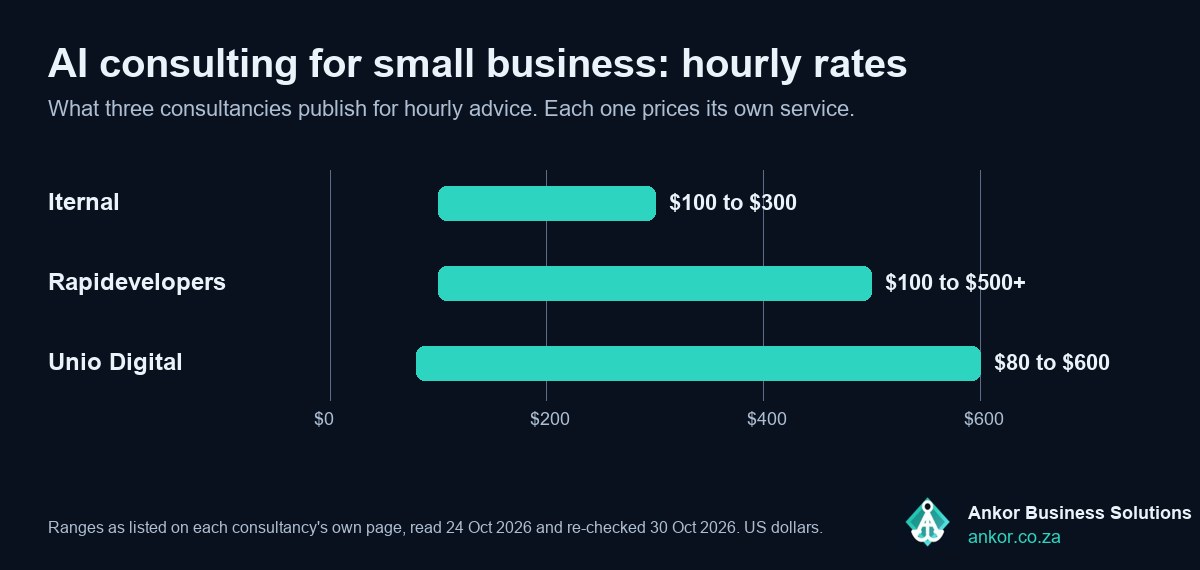
Three things stand out. First, hourly rates overlap heavily, from $80 to $600 across the three. Second, fixed projects cluster between $2,000 and $10,000 on the two pages that give a figure. Third, retainers vary the most, and Unio’s sit well above Iternal’s. A retainer is the easiest line on any quote to inflate, so ask what you receive each month.
Two more costs sit outside the consultant’s fee. Iternal says tools are billed separately and often $20 to $50 per user per month. The AI Consulting Network lists a 45-minute strategy call at $500, credited toward any engagement. Its pages are aimed at commercial real estate, so that price will not apply to every business.
Rapidevelopers makes a point worth keeping. It describes a $3,000 assessment that produces a list of 25 ideas next to a $12,000 project that leaves you with one working pilot. The cheaper option is not always the cheaper outcome. Decide whether you are buying advice or a working result.
What should you ask before you pay for AI consulting?
- What exactly will I have at the end? A report, a working workflow, a trained team? Ask for it in writing.
- Who does the work? The person on the sales call, or someone junior?
- Which tools will you use, and who owns the accounts? You should own every account, login and file. If the setup lives in the consultant’s account, you are renting it.
- What do the tools cost each month after you leave? The project fee is only part of it.
- Can you show me one similar small business you helped? Then ask that business whether it still uses the result.
- What happens to my customer data? Ask where it goes and who can see it.
- Who approves what the AI sends out? The answer should be you.
- How will we know it worked? Pick one number, such as hours saved a week, before the work starts.
What are the red flags?
- A guaranteed return. Nobody can promise one for your business.
- A twelve-month roadmap for a five-person company. Small businesses need one or two things working this quarter.
- No fixed scope. “Ongoing AI strategy” with no monthly deliverable is a meter, not a plan.
- Vague answers about data. If they cannot say where your customer information goes, walk away.
- Everything lives in their accounts. You cannot leave without losing the work.
- Pressure to sign fast. A good consultant is fine with you comparing quotes.
Can a very small business skip AI consulting?
Often, yes, at least for the first step. If you run a one-person or very small business, you can do the planning part yourself in an afternoon, then buy help only where you get stuck. A plan that fits on one page has one big advantage over a thick binder: someone actually reads it. Here is that path:
- List your repeat jobs. For one week, write down every task you do more than twice: replies, quotes, follow-ups, scheduling.
- Pick one. Choose the one that costs you the most hours or the most missed money.
- Write down who owns it, what “done” looks like, and a date to start. Our post on an AI implementation plan walks through a one-page version of this.
- Try it in an AI assistant you already use. ChatGPT, Claude and Gemini can all draft replies and quotes from your own instructions. You read and approve every draft.
- Count the result after two weeks. Did it save time? Keep it. If it did not, you have lost very little.
If you want to go from “one job” to “a team of AI helpers”, our post on AI agents for small business explains what an AI agent is (an assistant that carries out a task for you, not only answers questions) and why starting with one workflow works best. Pay a consultant when you are stuck, short of time, or the job touches customer data you do not feel safe handling alone.
Where does Ankor fit?
Ankor is not a consultancy, and it does not charge by the hour. It sells ready-made systems that run in your own ChatGPT, Claude or Gemini account, and it sets them up with you if you ask.
The closest match to the “done with you” model is Ankor Nexa. Its page describes it as a set of instructions you add to the assistant you already pay for. It includes 55 skills (a skill is a set of step-by-step instructions the assistant follows) and 39 workflows for jobs such as weekly planning, proposals, sales follow-ups and client onboarding. It drafts, and you decide: nothing is sent, published or paid without your yes.
The page shows R17 500$999 once-off, or US$129 a month on the month-to-month option. If you would like someone to install it with you, the page lists a setup add-on of R2 500$100 extra, R20 000$1,099 in total. The setup is one online session of up to 90 minutes on your own account, followed by a one-page summary and one follow-up email within seven days. It does not cover your website, email or accounting software. Extra hands-on help costs US$75 an hour internationally, per the setup session page.
Be clear about what that is. It is a product with one setup session, not a custom consulting project, so it will not redesign your business. The page says it is built for businesses with staff, contractors or several clients at once. If you work alone, the one-person Essential Business Package on the shop page is a smaller option, and if you need a custom build, a consultant from the table above may suit you better.
Try it free for 7 days in ChatGPT or Claude. No card needed. If it suits you, buy it once off or month to month.
Questions owners ask
How much should a small business spend on AI consulting?
There is no set figure. Published estimates run from free readiness checks to $10,000 or more for a fixed project. A sensible start is a small, defined piece of work with a clear result, not a long retainer. Decide in advance what one hour saved a week is worth to you.
Is a retainer or a fixed project better for a small business?
A fixed project usually fits better at the start, because you know the cost and the result. A retainer can make sense later, once AI touches several parts of the business and you want an advisor on call.
What is an AI implementation plan?
It is a short document that says which job AI will help with, who owns it, what success looks like and when it starts. A one-page plan is enough for a small business.
Do I need AI consulting if I only use ChatGPT?
Not necessarily. If you use ChatGPT, Claude or Gemini for a few jobs and you approve everything it writes, you can often improve it yourself. Consider help when you want a repeatable system, or the work involves customer data.
Are the prices in this post guaranteed?
No. They were read from each company’s own page on 24 October 2026 and can change. Ask any consultant for a written quote.
Your first step this week
Write down the five tasks you repeat most. Circle the one that costs you the most time, then spend 30 minutes writing what a good result looks like. That page is the most useful thing you can bring to any consultant, and it may show you that you can start without one. If you would like to talk it through, email admin@ankor.co.za and tell us what is slowing you down.
Ankor tips
Stay in the loop
Practical AI tips for small businesses and the odd product update. No spam, unsubscribe any time.

