Quick answer. What comes after ChatGPT: The next chapter is not a chatbot with better manners. It is AI that already knows the situation, and can act on it. Written for small-business owners.
Sam Altman has been dropping fairly loud hints about where OpenAI is going next, and if you use ChatGPT every day, one of them deserves your full attention.
The next chapter is not a chatbot with better manners and a bigger vocabulary. It is AI that understands your context. AI that knows what you are working on, remembers what happened last week, and eventually stops answering questions so it can start finishing tasks.
That is a much bigger deal than another model release, and it is going to be quietly awkward for anyone who thinks “we did AI already, we bought some licences in March”.
The short version
- Today’s ChatGPT is brilliant but amnesiac. You spend half your time re-explaining your own life to it.
- The next phase is context plus agents: AI that knows the situation and can take action across your tools.
- That turns AI from a software purchase into an operating model question.
- The scarce resource stops being production and becomes attention, trust and distribution.
- Nobody is going to announce the change on a Tuesday. It will happen slowly, then all at once.
How we actually use ChatGPT right now
Be honest about the current ritual. You open ChatGPT. You type a question. You paste in three paragraphs of background it should really already know. You upload a document. You clarify. You clarify again. You get something genuinely useful, then you close the tab, and tomorrow the whole performance starts over from zero.
It is powerful. It is also a bit like having a world class consultant with no memory whatsoever. Every single morning you shake their hand and explain who you are and what your company does. Impressive brain. Exhausting onboarding.
The limitation was never intelligence. The limitation is context.
Intelligence without context has a ceiling
Now imagine the same intelligence, except it already knows your projects, your clients, your preferences, the decisions you made in Monday’s meeting and the three documents that actually matter.
You stop describing the situation and start describing the outcome.
Take a boring, familiar example. Today you say: “Summarise this meeting and write an email to my team.” Useful, but you are still the one carrying the context in your head, and you will still write six follow up prompts.
The version that is coming looks different. The AI already understands the meeting, the project, the people involved and the decisions that were taken. It drafts the email, updates the task list, flags the one decision that is still open, and tells you what it needs from you. You are no longer prompting. You are supervising.
That is the difference between an AI assistant and something closer to an operating layer for your work.
Agents: the actual plot twist
For the first stretch of generative AI, the pattern was simple. Human asks, AI answers. Lovely. Very tidy.
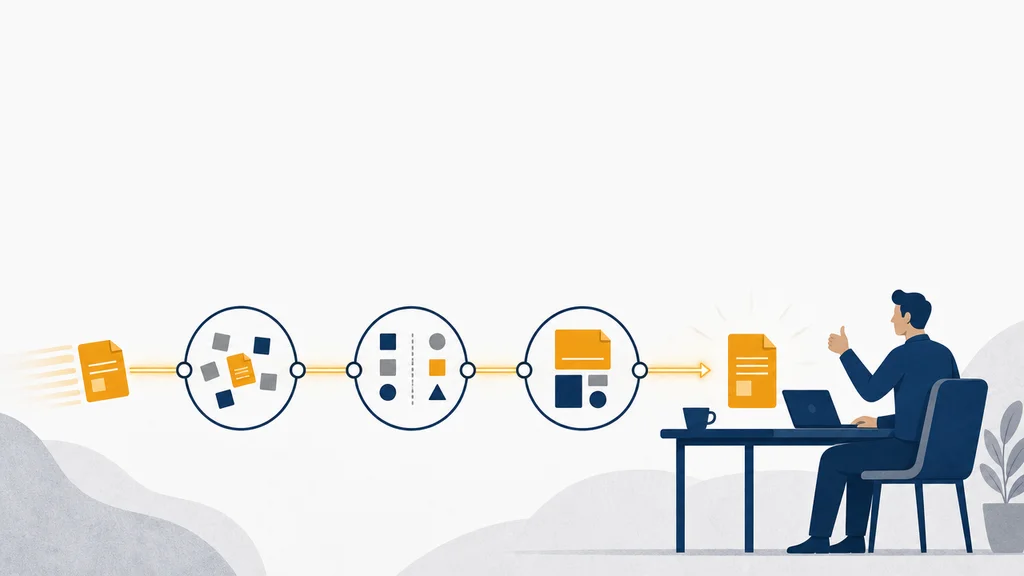
Agents break that pattern. The new loop runs like this:
- Human defines an objective.
- AI reasons about how to get there.
- AI uses tools.
- AI performs the task.
- AI checks its own results.
- AI keeps going until the objective is done, or until it hits a checkpoint that needs you.
That is not a feature update. That is a different way of using a computer, and an early version of it is already shipping in ChatGPT Work, which can browse and act on your behalf.
Which is why judging AI purely on “whose chatbot gives the nicest answer” is a bit like judging cars on cup holder quality. Fine detail, wrong competition.
The real race is context, not cleverness
The more interesting questions are these. Which AI understands me best? Which AI has access to the most useful tools? Which AI can turn intelligence into action I actually trust?
Look at who is holding which cards:
- Google sits on an enormous pile of context through products people already live inside.
- Microsoft is welded into enterprise workflows through productivity software.
- Apple owns the personal device sitting in hundreds of millions of pockets.
- OpenAI has ChatGPT, the habit, and the brand recognition of the entire category.
So OpenAI’s challenge is not only building smarter models. It is turning that intelligence into something people trust enough to hand real context to, every day, without flinching.
The trust problem you cannot skip past
Here is the uncomfortable trade. The more context AI has, the more useful it becomes. The more context AI has, the more responsibility sits with whoever built it.
Picture giving an AI access to your email, your calendar, your client documents, your financials and your team’s messages. The upside is enormous. So are the questions:
- Who can access this information?
- How is it protected?
- How much control do I keep?
- What happens when it gets something wrong?
- Can I see why it made a decision?
- Can I stop it before it does something expensive?
These are not footnotes for the legal team to worry about later. They will decide which platforms people actually adopt. We went through the practical version of this, including what to lock down first, after the Hugging Face incident.
For businesses, this is an operating model change
Plenty of organisations are still treating generative AI as a normal software rollout. Buy licences. Launch a chatbot. Run a pilot. Do a lunchtime training session. Measure adoption. Tick the box. Put it in the board pack.
That approach badly underestimates what is happening.
If AI keeps moving toward contextual, agentic systems, companies will eventually have to redesign parts of how they operate. A traditional organisation is made of people, processes, applications, data, policies, approvals, business units and decision rights. Drop AI agents that can do meaningful chunks of knowledge work into that structure and some genuinely hard questions surface:
- Which decisions can an AI make on its own?
- Which actions require a human signature?
- Which systems can an agent touch?
- Who owns a given agent?
- How do we audit what it did?
- How do we trace which information produced an answer?
- Who is accountable when it goes wrong?
You cannot answer those with a licence renewal. That is governance, and it is the part everyone would rather postpone.
The one thing AI cannot mass produce
AI is driving the cost of creating things toward the floor. Software, analysis, decks, research, content, business models, entire digital products.
But there is one resource it cannot manufacture more of: human attention.
If everybody can produce more, the world simply fills up with more. More apps, more content, more newsletters, more messages, more noise. So the scarce goods become attention, trust and distribution.
That flips the usual advice on its head. The winners of this era are probably not the organisations that produce the most. They are the ones that produce something worth trusting, and can get the right people to look at it.
What it means for your career
There are two ways to react to increasingly capable AI.
The first is to ask “will AI replace my job”, which is understandable and also fairly paralysing.
The second is more useful: “how much more capable can I become when I work with it properly?”
Knowing how to use ChatGPT will stop being a differentiator, in the same way that knowing how to use email stopped being one. The advantage moves to the people who can delegate work to AI, supply good context, evaluate the output critically, connect tools together, build repeatable workflows, and choose which problems are worth solving in the first place.
Two people, same eight hour day. One spends it manually gathering information, analysing it and writing a report. The other designs a workflow that produces the first 80 percent automatically, then spends the day challenging assumptions and improving the decision.
Identical working hours. Completely different productive capacity.
The pressing question was never “will AI outsmart humans”. It is what happens when people using AI well compete with people and companies that are not.
Nobody is going to fire a starting pistol
There will probably be no single dramatic morning where somebody declares AGI has arrived and the world stops to watch.
Technology rarely behaves that neatly. AI gets a bit more capable. Agents get more reliable. Context improves. One more workflow quietly gets automated, then another, then another. And then one day you look up and knowledge work simply operates differently.
Waiting for an official announcement is a strategy for missing the whole thing. It happens gradually, and then it feels sudden.
What to actually do about it this month
If you are an individual
- Push past basic prompting. Give AI a real problem, not a test.
- Use it for research, planning, writing, coding, learning and decision preparation.
- Pay close attention to where it fails. That map is worth more than any prompt library.
- Start keeping reusable context: your standard briefs, your tone, your client background.
If you lead a business
- Stop asking “where can we deploy ChatGPT”. Start with one workflow instead of a chatbot, then ask what your organisation would look like if intelligence became cheap and available everywhere.
- Which processes change? Which capabilities matter more? Which roles evolve?
- Which decisions could be accelerated, and which absolutely should not be?
- Which knowledge should be made accessible to AI, and which should never be?
- What governance has to exist before an agent is allowed to act on your behalf?
Those are strategy questions, not IT questions. The companies answering them now will have a real advantage over the ones waiting for AI to be “finished”, which is a bit like waiting for the internet to be finished.
If you would rather not build all of that from a blank page, our AI business systems are put together around exactly this shift.
Frequently asked questions
What comes after ChatGPT?
Not a smarter chatbot. The direction is contextual, agentic AI: systems that understand your situation, use tools on your behalf and complete multi step tasks rather than only returning answers.
What is an AI agent, in plain language?
An AI that is given an objective rather than a question. It plans, uses tools, does the work, checks the result and repeats until the objective is met or it needs your approval.
Do small businesses need to care about this yet?
Yes, and arguably more than large ones. Small teams can restructure how they work in a week. Enterprises need eighteen months and a committee. That is a genuine advantage, so use it.
Is it safe to give AI access to my business information?
It depends entirely on the controls: access limits, audit trails, human approval on consequential actions and a clear off switch. Decide your rules before you connect anything, not after.
Will AI take my job?
The more immediate risk is not the AI. It is the person doing your job with AI while you are still doing it by hand.
The bottom line
ChatGPT changed how millions of people interact with AI. Agents will change how people interact with software. Contextual AI could change the relationship between people and computers altogether, moving us from a world where we operate software to one where we describe outcomes and intelligent systems handle the machinery.
Optimism is fair here. Blind adoption is not. The people and organisations who come out of this well will pair experimentation with responsibility, speed with governance, automation with human judgement, and intelligence with trust.
Sam Altman is clearly thinking well past the chatbot on your screen today. The better question is whether the rest of us are.
Over to you: would you give AI far more context about your work and your life if it made the AI dramatically more useful? Or does that level of access make you want to lie down? Both answers are reasonable. Tell me which one is yours.
And if you want this kind of breakdown every week rather than once, the AI Business Updates list is where it lands first.
Stay in the loop
Get practical AI tips and product updates, no spam, unsubscribe any time.