AI discoverability refers to whether AI assistants like ChatGPT, Claude, Perplexity, and Google’s AI can find a business online, accurately understand its offerings, target audience, and location, and correctly relay this information when queried. The guide explains that assistants rely on website text, structured data, public profiles, robots.txt permissions, and consistency across platforms to describe businesses accurately.
The content outlines three key checks: whether assistants can read a site, whether they understand the business, and whether they trust the details based on consistency. It clarifies that discoverability is not advertising, SEO replacement, or a guaranteed recommendation, and describes services like audits and monitoring to help small businesses improve their visibility to AI tools.
On this page
What is AI discoverability?
Quick answer: AI discoverability is whether AI assistants such as ChatGPT, Claude, Perplexity and Google’s AI can find your business online, understand what you do, for whom and where, and repeat those details correctly when someone asks. If they can’t, you are left out of the answer and you never find out.
You will also hear it called AI visibility, answer engine optimisation (AEO) or generative engine optimisation (GEO). The label matters less than the question behind it: when a potential customer asks an AI assistant for a business like yours, does it find you and get your details right? Our guide What is GEO? explains that term in plain English.
Why this matters even if you have never used ChatGPT
Think about how a customer found you five years ago. They typed a few words into Google, scrolled a list of blue links, opened two or three websites and compared. Your website only had to be on that list.
Now a growing number of people skip the list. They open an AI assistant on their phone and type a full question, the way they would ask a friend: “Who does small-business bookkeeping in Somerset West and works with sole traders?” The assistant reads what it can find online and gives one answer, often with two or three names in it. The question could just as easily be about a plumber in Denver, a physio in Pretoria or a tutor in Manchester.
If your business is not in that answer, the customer does not see a list to scroll further down. There is no page two. They phone the name the assistant gave them.
That is the whole reason AI discoverability matters. Not because AI is clever, but because it is now a front door that some of your customers walk through, and you cannot see who was turned away.
What an AI assistant actually looks at
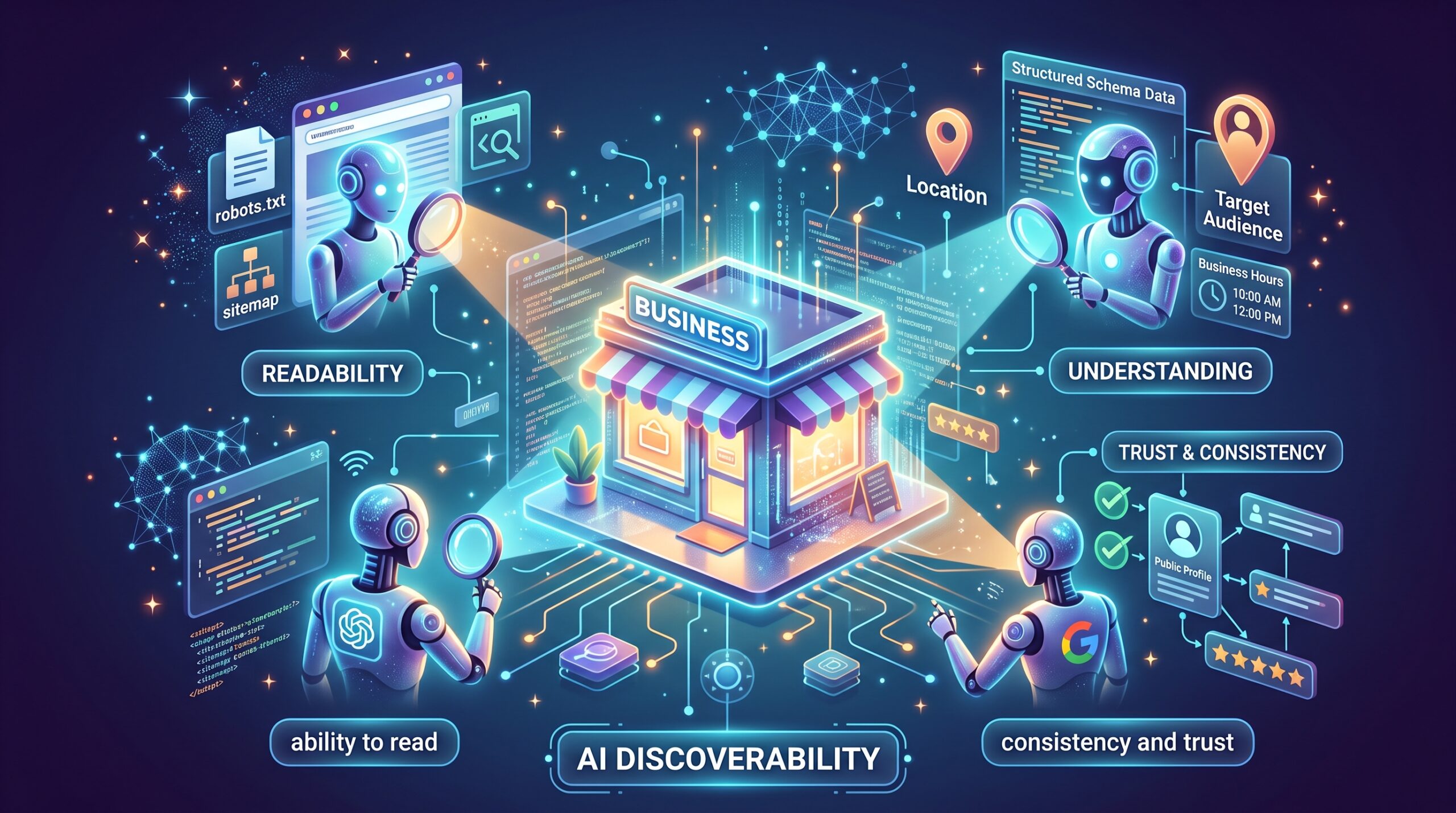
An AI assistant does not “know” your business. It reads. ChatGPT, Claude, Perplexity, Microsoft Copilot and Google’s Gemini and AI Overviews all read the public web in broadly the same way, so one clear, consistent website covers all of them at once. When an assistant answers a question, it looks at:
- Your website text. The words on your pages, in plain reading order. If your home page says “Welcome to our website” and nothing about what you sell, the assistant learns nothing.
- Structured data. A small block of code behind the page that spells out your business name, address, phone number, opening hours, services and prices in a form machines can read without guessing. You cannot see it as a visitor, but the assistant can. Google publishes the format for local businesses in its LocalBusiness structured data guide.
- Your public profiles. Your Google Business Profile, Facebook page, directory listings and anywhere else your name, address and phone number appear.
- Permission to read. A file on your website called
robots.txttells automated readers what they may look at. Some websites block AI readers by accident, usually because a plugin or a well-meaning developer did it years ago. OpenAI, for example, explains in its crawler documentation how its readers, such as GPTBot, follow those instructions. - Consistency. If your website says one address, Google says another and Facebook says a third, the assistant has no way to tell which is current. It will often leave you out rather than guess.
None of this requires you to understand AI. It requires your business to be described clearly, consistently and in a form machines can read. Most of the fixes are small.
The three questions behind AI discoverability
When Ankor checks a website for a client, the plain-language version of the check comes down to three questions:
- Can the assistant read it? Is the important text actually on the page, or hidden inside images, sliders and pop-ups? Is anything blocking automated readers?
- Does it understand what you do? Does each key page say, in ordinary words, what the service is, who it is for and where you work? Is that backed up by structured data?
- Does it trust the details? Do your name, address, phone number, services and prices match across your website, Google and your other profiles?
If the answer to all three is yes, you are discoverable. If any answer is no, the assistant either skips you or describes a version of your business that no longer exists.
A common example
Imagine a physiotherapy practice that moved premises two years ago. The website was updated. The Google listing was updated. The old address still sits on three directory sites nobody remembers signing up to, and the practice’s “About” page still says “serving the northern suburbs” from before the move.
A customer asks an assistant for a physio near the new area. The assistant finds four different addresses and a page that says the practice works somewhere else. It recommends a competitor whose details all agree.
Nobody at the practice did anything wrong. The internet simply kept describing the business they used to be.
AI discoverability for small business: where to start
If you only have an hour this month, spend it on the boring bits. They matter most, and they are the ones most often wrong.
- Your first screen. One plain sentence: what you do, for whom, and where. “Bookkeeping for sole traders in Austin” beats “Welcome to our family”.
- One set of details. Pick the exact business name, address, phone number and hours you want the world to use, and make every profile match it.
- One page per service. If you offer three services, give each its own page with its own plain description. An assistant cannot recommend a service it never read about.
- Old listings. Search your business name and old address together. Every outdated directory listing you fix is one less wrong answer.
None of this is glamorous. Good AI discoverability for a small business is mostly tidy housekeeping, done once properly and then checked now and then. For a step by step version written for owners, see how to get ChatGPT to recommend your business.
What AI discoverability is not
- It is not a guarantee that ChatGPT will recommend you. No service can promise that, and the platforms decide what they show. Discoverability is about giving them correct information to work with.
- It is not the same as advertising. You are not paying to appear in an answer; you are making sure you can be found and described correctly.
- It is not a replacement for ordinary search engine optimisation. It sits on top of it, and the same clean, honest website helps both. (More on that in our post on AI discoverability versus SEO.)
- It is not something you can set up once and forget. AI tools change, your business changes, and details drift.
How to check your AI discoverability in ten minutes
You can do a rough check yourself before you pay anyone. Our post Does ChatGPT know your business exists? walks through it in detail. The short version:
- Ask an assistant about your business. Open ChatGPT, Claude or Perplexity and ask what your business does, using your business name and town. Then ask the question a customer would ask, without your name in it. Note what comes back and what is wrong or missing.
- Read your home page as a stranger. On the first screen, does it say what you do, who you do it for and where? If it only says “Welcome”, that is your first fix.
- Compare your details across the web. Check that your business name, address, phone number, hours and services match on your website, your Google Business Profile and your Facebook page.
- Check that automated readers are allowed in. Type your website address followed by
/robots.txtinto a browser. If you see lines that disallow everything, or that name readers such as GPTBot, ClaudeBot or PerplexityBot, ask whoever looks after your website whether that was intended. - Test your structured data. Paste your home page address into Google’s free Rich Results Test. If it finds nothing, the assistants are working from your page text alone and guessing at the rest.
Once you know where the gaps are, our earlier guide covers five practical ways to improve AI search visibility.
If you would rather have someone look properly, Ankor offers three done-for-you services, explained on the AI Discoverability page:
- The AI Discoverability Audit checks up to ten key pages and gives you a plain-language report on what the assistants can and cannot read, and what to fix first. The report is yours whether or not you ask us to fix anything. If you want a taste first, the free AI Visibility Snapshot on the same form looks at your home page and up to two other pages and sends you three findings, reviewed by a person.
- The AI Discoverability Setup makes the agreed fixes on up to ten key pages within one working week and shows you exactly what changed.
- AI Visibility Monitoring re-checks your website every month and sends a one-page report with up to three next steps.
Nothing is charged until you have accepted a written quote, and you approve every change before it goes live.
AI discoverability: questions owners ask
Do I need to use AI myself for this to matter?
No. It is about your customers using AI to find a business, not about you using AI. You can never open ChatGPT and still lose customers who did.
Is AI discoverability only for big companies?
No. Small local businesses are often the ones a customer asks an assistant about, because the question is local and specific. A clear, consistent website is enough to be in the running.
Can I fix AI discoverability myself?
Often, yes. Clear page text, matching business details and a correct Google Business Profile cover a lot. Structured data and permission files are more technical, which is where an audit or a setup service helps.
How long does it take to see a difference?
It varies and nobody can promise a date. AI assistants re-read websites on their own schedules. What you control is whether the information is correct when they do.
Does Ankor guarantee that AI will recommend my business?
No. We improve what the assistants can read and understand about your business and show you what changed. What they do with it is up to them.
Is AI discoverability the same as SEO?
No. SEO helps your pages rank in a list of search results. AI discoverability is whether an assistant can read, understand and trust your business details well enough to include you in a single answer. The same clear, consistent website helps both, so you do not have to choose.
Your first step this week
Ask one AI assistant the question a new customer would ask, without your business name in it. Write down what comes back. That one answer tells you more about your AI discoverability than any report, and it costs you two minutes and a slightly bruised ego.
Written for small-business owners by Ankor Business Solutions. If you are not sure where to start, choose the free AI Visibility Snapshot on the Audit request form.
Ankor tips
Stay in the loop
Practical AI tips for small businesses and the odd product update. No spam, unsubscribe any time.

